Our longterm plan is transform the chapel into a family home, critically maintaining the heritage and beauty of the building while giving it a sustainable future. The thinking is that we will retain the main hall as is on the outside, but will need to replace the two extensions; the school room extension has significant structural problems requiring it to be rebuilt, and the rear kitchen extension has practicality challenge. Consideration will be given at the design stage to exactly how this works, and how we visually and technically integrate this with maintaining the core of the building (the main hall) in its current context. Internally, our thinking is to erect a steel frame within the hall to lift the floor level (due to flood risk) and create at least one mezzanine floor, enabling the space to be used for a mixture of rooms within the home. We do know however we are going to need to have the main hall repointed with lime mortar, the roof overhauled, and the windows and doors overhauled or replaced but looking identical.
For clarity, this will all be subject to design and planning permission – and we anticipate this to be a lengthy process.
Our project plan has five conceptual phases:
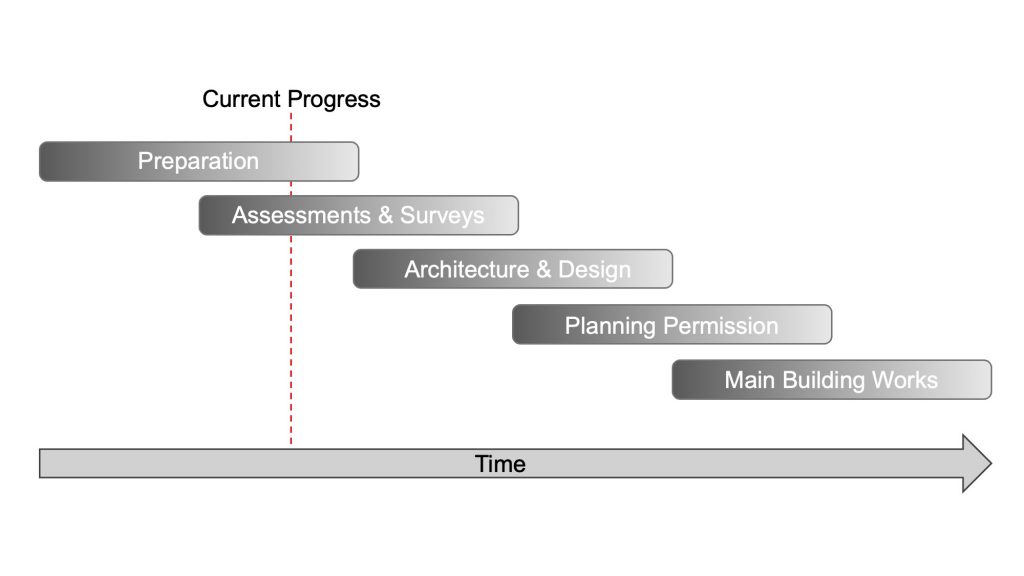
Preparation Phase
This initial phase includes bringing the building and site to a good state of maintenance and repair, getting the chapelyard in good order including tree work, installing security systems, separating the area to be used for the future residential property from the cemetery areas, and dealing with outstanding issues such as nuisance overlying cables.
We are progressing well with this, with the building fully cleaned and advanced security systems installed including CCTV, the chapelyard tightly maintained, tree work under way, and the work to separate the property areas for the cemeteries progressing. Specifically we undertook a consultation inline with the Disused Burial Ground Act to enable us to move some of the memorials to create to two defined cemetery areas in the chapelyard. Full details of this can be found in the consultation document. Thank you to all who engaged in this, it was hugely appreciated.
Based on the output of the consultation, we are now carefully and reverently managing the move of the affected memorials. To reiterate – no remains will be disturbed or moved.
In parallel to this we will be looking to form the new entrances for these cemetery areas, and enable us to create the separation between the cemetery and building spaces. We have had the wrought iron gate (for the area nearest the post office) professionally sand blasted and repainted.
Once all these works are complete, and in particular the area is configured such that the cemeteries and memorials are separated, fully maintained, and definitely will not be affected by the renovation/transformation plans for the buildings, we will consider this phase complete.
Assessments & Survey Phase
There are a number of challenges that affect the ability to renovate and transform the building for residential use, not least resolving the issue of flooding. The building is a flood risk area – specifically from the adjacent watercourse “Ditchend Brook’.
From all the records, we are only aware of a single time the building has flooded which was on 24th June 1983, when a flash flood engulfed the village, the result of several days of rain followed by a heavy thunderstorm. We understand the church, vestry and schoolroom were flooded to a depth of 4 inches.
To provide the level of assurance required and due to a lack of available data, we will need to commission an exercise to technically assess the flooding risk for the chapel, and specifically the worst case scenario allowing for climate change. We will then take the worst case flood water heights, add a good margin, and set the ground floor heights at this level such that the completed residential building could never flood. We will also deal with the other aspects required for the assessment such as escape routes. This whole activity is going to be costly, and we intend to commission this once we have completed the core of the preparation works and have the funds available.
As a precursor to the flooding assessment and all other work, we have needed a full measured and topographical survey – this has been completed by Hillcrest Surveys who have done an excellent job.
We will need a number of other assessments and surveys to ensure the design of the conversion and other necessary upgrades will be successful, compliant and approved.
Architecture & Design Phase
As previously described , our intention is to retain the main hall exterior as is, and preserve the heritage as closely as possible. We will have to replace the two extensions, and will look to create a scheme here that works in together with the main hall, but also doesn’t try to show history/heritage that isn’t there. We will be looking for expert advice, consultancy and design work here from a suitable architect. We are currently working with a potential architect to understand costs, but we will not be bale to instruct the architect until we have funding for this work. Additionally, we will use the architect to design the interior of the building.
Further to this we will undertake design activities related to key supporting aspects such as the replacement of the septic tank with a sewage treatment plant, supply of utilities, and external works.
Planning Permission Phase
Once we have all the necessary assessments and high level design in place, we intend to apply for planning permission to change the use of the building, and undertake the replacement of the extensions. This will be done with full engagement with the parish council particularly, as we are keen to ensure we bring forward a scheme that maintains the heritage and adds value to the village and vernacular design.
Main Building Works Phase
Main construction will not start until planning permission is in place.
However, we are undertaking the groundworks related to the separation of the cemetery areas. Further, we may undertake remedial, maintenance or repair work that ideally contributes to the later renovation – such as repointing in lime and renovating the roof.
As described, the plan to transform the building is significant in scale, and is going to take a notable period of time. We will keep this page updated with progress on the future plans; in the meantime you can follow whats going on via our progress blog.
If you have any questions or thoughts, please don’t hesitate to contact us.