This page is constructed from on a transcription of the latest (2006) edition of the history booklet text (with no modifications intended), augmented with scans of the original printed graphics from in the original edition (1956).
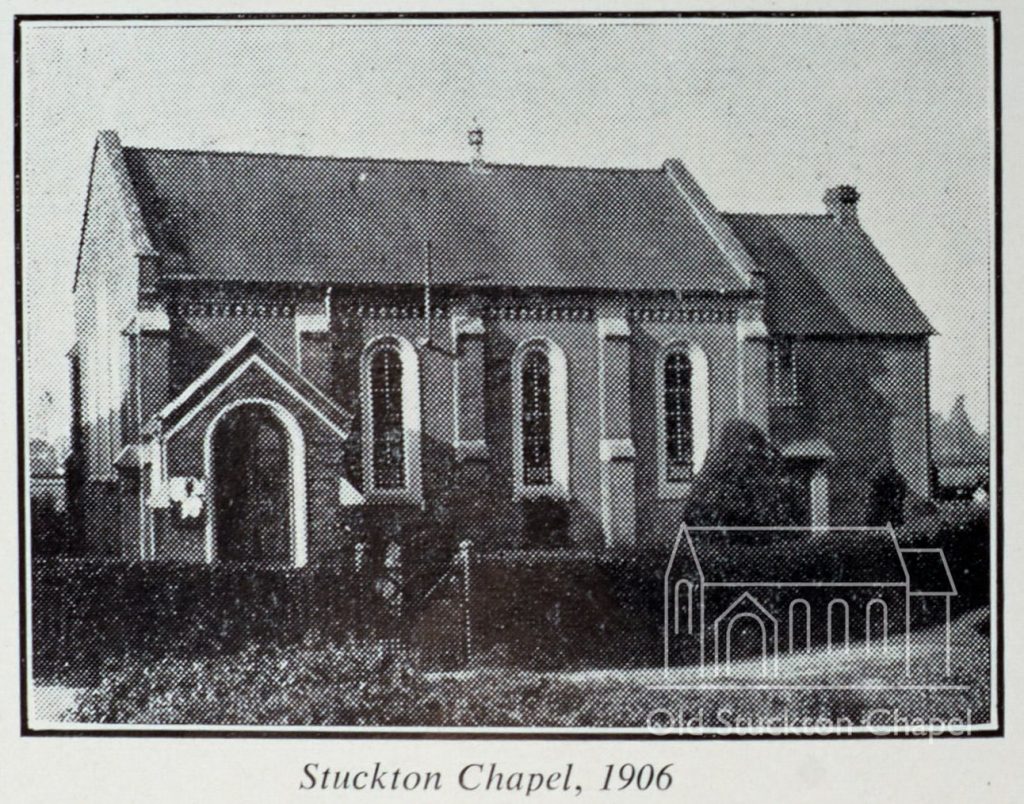
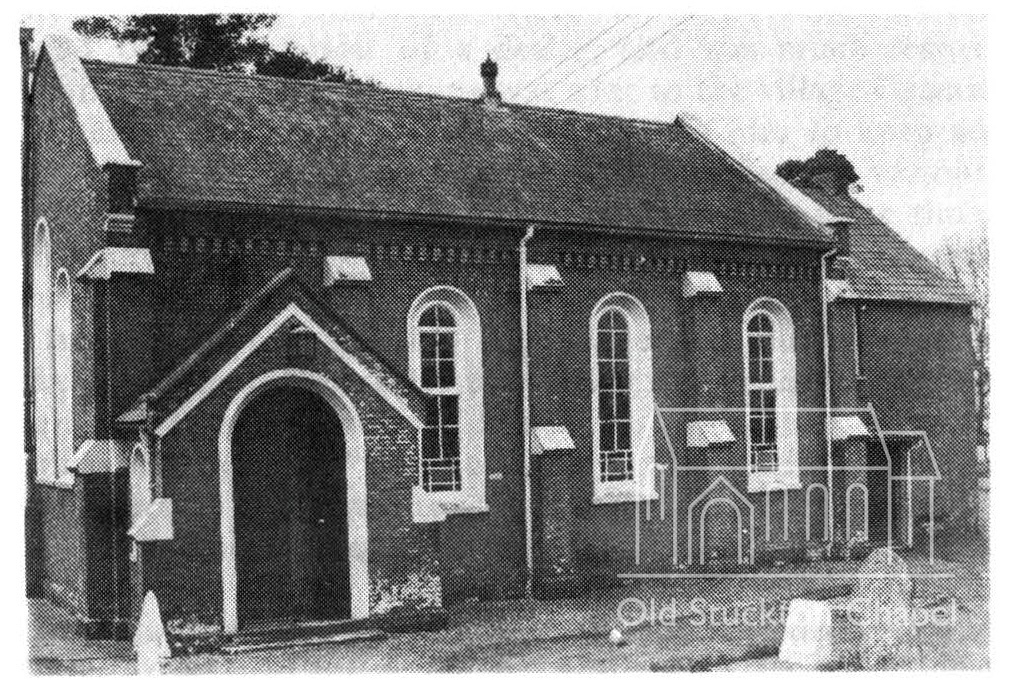
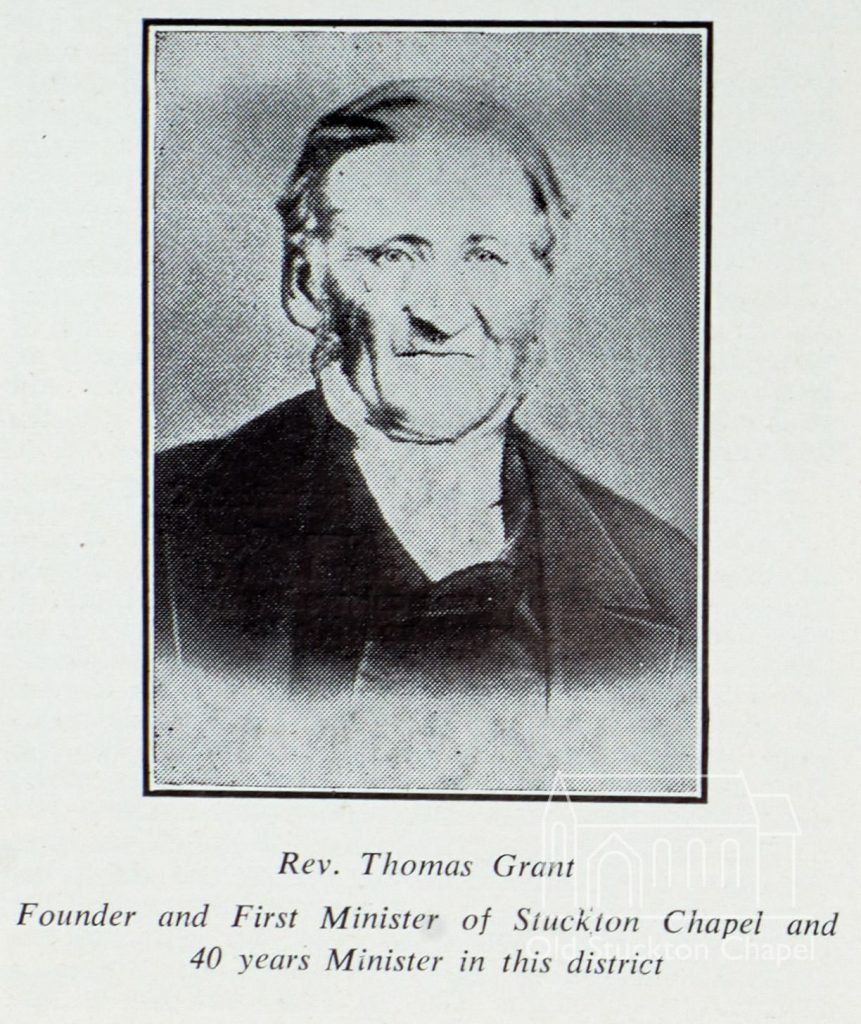
The Stuckton Congregational Chapel was opened on Tuesday the 16th September, 1856, and is largely a memorial to the very high esteem the Christian public of those days had for the life, character and activity of one man, the Rev. Thomas Grant, for it was around his witness to the saving grace and power of Jesus Christ that the Church was formed and built.
1 – The Early Years of Thomas Grant.
Thomas Grant was born at Bath on February the 13th, 1790. His father was butler, and his mother housekeeper in the family of D. Egerton, Esq., a nephew of the 4th Earl of Bridgwater. They subsequently moved to Lyndhurst in the New Forest, where Mr. Grant’s father possessed a small freehold, and followed the occupation of a dealer, and was much respected in the district. At the age of nine, Thomas was sent to the village Grammar School, where he obtained sufficient education to qualify him to keep accounts. He remained at school about seven years and, after following various trades, he became a clerk in a public office and, much about the same time, his father received an appointment under the Crown at Wootton, near Lymington. Not long afterwards his father died as the result of a fall from a horse while returning from Romsey, and his son succeeded him in his office, and remained in it for several years. He married at the age of twenty-one, and had five children, two of whom survived him.
Up to this time he was “without God in the world”, convivial, fond of worldly amusements, and given to gaiety and pleasure. Eventually God began to “reckon” with him. One of his little children, a fine girl of seven, died of the whooping cough. A little time before she died she sang a hymn by Isaac Watts, and this touched her father’s heart, and he regarded it as a visitation of God, and later as he held the dying girl in his arms, he said, “Lord, why hast Thou taken the innocent and spared the guilty?” This was the beginning of the spiritual conflict that terminated in his conversion. This conflict lasted about two years and during this time he visited the various churches and chapels in the district. He eventually went to Southampton and there heard the Rev. Thomas Adkins, and the truth was greatly blessed to his soul. He had several dark moments after this. His wife died, and he moved to Hungerford in another part of the New Forest, but assurance of Salvation came at last and he felt relieved of the burden he had carried so long.
In his new situation he continued for many years, and married again, and was gradually led into the course of Christian service by which the neighbourhood was so greatly blessed. When he first arrived in Hungerford, in the year 1821, it was a picture of desolation. The cottage he lived in was 2 miles from any house, and he had not one friend he could speak to. The scattered villagers were very poor; there was no place of worship, no school, no visitation, no institution of any kind that could be of help to the spiritual and temporal welfare of the people. The result of this was that gross ignorance and immorality prevailed.
Not many years passed before all this was changed by the influence of Thomas Grant. The way in which this came about is best told in his own words, “I resolved”, he says, “to go of a Sabbath afternoon to spend an hour with my wife’s friends, who were getting aged, and fond of religious instruction. I used to read and explain a few passages of Scripture, and they were pleased and edified. I also much enjoyed it. When it was known that I came down regularly, another relation desired permission to attend, which was not objected to. This soon enlarged our company, till the house was filled. I then considered the position I was in, and the onerous work in which I was engaged. I made resolutions to give it up. As the work thickened upon me, week after week I resolved should be the last. But when the next Sabbath came, I felt an impulse, which I could not resist. The congregation now increased so much that the house would not hold them. A larger house was offered, with the same result. Even the staircase was crowded, and now what to do I did not know. I had gone too far to go back. I was indeed perplexed. I had long known how desirable a chapel was, but the question was how to get it erected. All the people were poor agricultural labourers, most of them with large families, and I myself had a family of seven children and my wages only 15/- a week. But after much consideration, and feeling confident that the Lord had sent me, I took courage.”
2 – The Founding of the Hungerford Church
It was in this way that Thomas Grant commenced and continued his labours. A chapel was built, and filled to overflowing. Then it was enlarged, and still filled. A third time it was enlarged, and filled again, with great spiritual benefit to the whole neighbourhood. Many of the worst characters were converted. A Christian Church was formed, and some of the ministers of the neighbourhood who had gradually became acquainted with the work that was going on, gathered together in July 1845, and ordained Mr. Grant into the Christian ministry.
The result attending the labours of Mr. Grant were not more remarkable than the manner in which the expense of erecting the chapel was met. The cost of the Hungerford Chapel was about £230. To meet this the congregation raised £7, and some friends who lived at a distance sent £15 more. The rest (£208) was paid by Mr. Grant himself. The way in which he obtained this great sum, while never earning more than 15/- a week to keep himself and his large family, illustrates his character and the providence of God. “It pleased the Lord”, he informs us, to give him a love for painting, books of art and classical works. He had an old tea tray in the house of which the japan had worn off, so he decided to get a few colours and repaint it. He did so, and painted round it what he thought was a very pretty border and hung it up to dry for the night. The next morning on inspecting his work he found all his labour lost. He had used too much oil with his colours with the result they had run in all directions.
While looking at the tray he thought he could trace in the lines made by the colours the form of a man and two dogs. He improved the outline, and then painted a gamekeeper with two spaniels. He showed this, his first work of art, to some friends, who expressed their pleasure. He made another effort, and was so successful that he sold this painting to the then Speaker of the House of Commons, C. S. Lefevre, Esq., M.P. After this he was introduced to John Proctor Anderson, Esq., who had a splendid collection of old masters, and he kindly gave Mr. Grant permission to copy from them. In this way he obtained some knowledge of colouring and began to paint game and animals, and found already sale for his work. Sir Hussey Vivian visited him and bought all he had and then brought fresh orders from his friends, the members of the New Forest Hunt, and others. The paintings were sold as fast as Mr. Grant could complete them. Sir Charles Hulse, Lord Palmerston, and Albert the Prince Consort were among the purchasers. These paintings were executed in what Mr. Grant was pleased to call his leisure hours, and on wet days when he was not able to follow his normal occupation. In all this he traced the hand of God, because it was the sale of his paintings that made the erection and subsequent additions possible. Eventually he was able to relinquish his situation under the Crown.
The lord of the Manor at this time was Eyre Coote, Esq., and he, observing the genuineness of the work done by the humble cottager, gave Mr. Grant the land upon which the Hungerford Chapel was built. Such was the friendship between the two that no legal conveyance of the land was asked for, or given. By the year 1850 the Chapel was capable of holding 300 persons. By the year 1855 the Chapel was full on most Sundays, and there were forty-six Communicant members, fifty-six Sunday School scholars and seven teachers. There were also forty-six Day School scholars attending the school attached to the Chapel.
3 – The Closing of the Hungerford Chapel.
Eventually the lord of the Manor died, and was succeeded by his son, and into his possession came all the property of the estate. At this time, also, a new clergyman came into the district, the Rev. R.P. Warren, M.A. Very soon a new spirit was seen in the new squire, and there began a series of events, which culminated in September of 1855 with the Rev. Thomas Grant being ejected from his own property. The new vicar took over the premises and started his own school, within sight of which Hyde Church was soon built.
On Thursday the 27th of September 1855, Thomas Grant and neighbouring ministers held a final meeting in the old Hungerford Chapel. (The ejection took place on Saturday the 29th.) There were present at this meeting, friends from Christchurch, Ringwood and Southampton. Sampson Payne, Esq., the then active and energetic Mayor of Southampton took the chair, and it was resolved to raise a fund for the erection of a new Chapel and Schoolroom, and also to compensate Mr. Grant for the loss of his property from which he was about to be ejected. The chairman headed the list with £10, and several additional substantial sums were promised. On the following Tuesday, the ejectment was complete, and Eyre Coote, Esq., took possession of Chapel, Schoolroom, Pews, and all other fittings which were the property of Mr. Grant, having been purchased with his own money.
The committee of ministers and laymen were soon active and an appeal was prepared and sent out far and wide. Public sympathy was rapidly evoked and soon contributions began to come in. By the time the new chapel was erected contributions had been received from every county in England, and £20 had arrived from India! The greatest problem the committee had to face was the obtaining of a piece of land. After very great difficulty a piece of land was offered, and the present site of the Stuckton Chapel was secured, it being the only plot of Freehold land available in the district, large enough for a chapel and burial ground. The members of the Fordingbridge Congregational Church were a little alarmed at first and protested that it was too near their own place of worship. For the committee, however, there was no alternative.
In the meantime Mr. Grant and his flock worshipped in a temporary building.
4 – The Opening of the Stuckton Chapel.
The chapel, which was erected under the supervision of Mr. Jurd, surveyor, of Southampton, was opened on the 16th September 1856. The first service of the day commenced at 11 o’clock. The first hymn was given out by the Rev. John Woodwork, of Totton. The Rev. T. Adkins preached from Haggai chapter ii, verse 9, “The glory of this latter house shall be greater than the former.” In his concluding remarks the preacher called on the members of the church, who had been ejected from a building dear to them because it was the birthplace of their souls, to be thankful and grateful to the great Creator that they had not been left as sheep without a shepherd, but that, in the Providence of God, sympathising friends had been raised up in all parts of the Christian world, who had come forward to their help and support. He hoped that that would be a day in which they would all gain good whilst doing good, and that they would “grow” in grace, and in the knowledge of the Lord and Saviour Jesus Christ. Among others who took part in this memorable service were the Reverends J. Fletcher, W. Roberts and G. Harris.
Dinner and tea were provided by the local friends and during the interval the visitors went to the old chapel and to Mr. Grant’s cottage where some of his pictures were exhibited.
At 5.30 p.m. a public meeting was held, presided over by Samuel Morley, Esq., of London, who was supported by the Reverends T. Adkins, W. Roberts, J. Woodwork, R. Laishley, all of Southampton; the Rev. H. J. Chancellor (Salisbury); the Rev. J. Fletcher (Christchurch); the Rev. G. Harris (Ringwood) and members of the Appeal Committee.
After an opening hymn the Rev. J. Woodwork offered prayer. The Chairman then expressed his personal pleasure in the privilege that was his, he having known Mr. Grant for many years. He said “it was the duty of all present to uphold the hands of so devoted a servant of God, and to strengthen that public opinion which said that a man had not the right, under all circumstances, to do what he liked with his own. Sympathy with these poor people had been evoked at great distance from the locality, and their proceedings would be made known abroad so that the British people would not tolerate conduct such as that which had been exhibited at Hungcrford and in many other of the rural districts of the land. The Christian public had, in this case, prevented a large amount of wrongdoing.
But for their stepping in as they had done, Mr. Grant’s work would have been impeded, if not entirely ended. Property had its duties and responsibilities as well as its rights, and men of property had no right to use it to impede God’s work, but should rather help it. He thanked the Rev. T. Adkins for his excellent sermon in the morning, which threw his own recollection back for many years, when he was a schoolboy at Southampton, and listened to that excellent man’s ministrations. He heartily thanked God for what He had done by Mr. Adkins’ instrumentality. As for the lord of the manor, he would himself rather be the village preacher (loud applause), because he believed there had been, on the part of this gentleman, a serious departure from what ought to guide him in his high and responsible position.
Mr. W. Champness, one of the secretaries of the Appeal Committee, next made a statement about the progress of the work. The total subscriptions to date were £782 5s. 1d. The total debt incurred £949 3s. 4d. He then read several letters from gentlemen of different denominations revealing the widespread zeal and sympathy that had been aroused.
The next speaker called upon was the Rev. T. Adkins and he remarked on the infinite importance of decision of character, in order to do any good, saying if ever he had met with an instance of that decision it was in Mr. Grant, who, having first felt the influence of Divine Truth in his own heart, he determined to help others in the same course. In doing that he had encountered dangers and difficulties, to overcome each of which was to him an inducement to meet another. He went on to refer to the triumph of religious liberty, and asked what had raised England to her present high position in the world but freedom of conscience. Who had kept alive the flame of liberty? The Puritans, the noble ancestors of those who were now the nonconformists of England. It was because he believed that this principle was recognised in the building that they had opened that day, that he rejoiced in its erection and the success of the cause connected with it. He could not look on the building in which they were now assembled, without blessing God that they lived under the broad aegis of their country – the shield of freedom and liberty. In times of persecution such men as Mr. Grant became martyrs. In times like these they gathered round them the sympathy and support of good men.
The Rev. G. Harris then spoke and vindicated all the statements made in the “Appeal”, not one of which they had seen any reason to question. They could not be too thankful to friends in Southampton, but for whose generous aid and exertion they could never have been assembled in that chapel today.
He closed by reading four letters from friends who had sent donations. Following this, the chairman stated they wished to raise £150 to compensate Mr. Grant, so that they still required £300. He had no doubt that there were some twenty persons then present willing to do something handsome, and he would make them an offer. If twenty persons would give, or raise, £10 each in six months, he would give £25. This would make £225 toward the £300, the remainder they would easily get, so that before the end of the next twelve months every atom of debt would be swept away.
The Rev. J. Fletcher spoke of the truth of the “Appeal” and of the fidelity of Mr. Grant. With reference to the site on which the chapel was placed, he deeply regretted that there should be any adverse feeling on the part of the friends at Fordingbridge1, but it was a fact that they could not get any other place near the old site. The building was a standing protest against any invasion of the freedom of conscience; it was a vindication of the right of the Christian Church, and liberty of opinion; it was memorial and sign that the Christian Public would not allow a brother to be trampled on when he was nobly and honestly doing his Master’s work. He enjoined union on the part of their friends, they were all labourers in one common cause.
Mr. W. Lankester spoke of the need for a temporary building, which had cost £106 and congratulated them on the result of the “Appeal”.
The Rev. J. Woodwork, referring to the early history of the Church, remarked that they had no reason to be ashamed of their origin or of their minister. The Rev. H. J. Chancellor expressed sympathy and gave £8 from his congregation at Salisbury, and promised £10. The Rev. W. Roberts proposed a hearty vote of thanks to Samuel Morley, Esq., for presiding on that occasion.
The Rev. Thomas Grant seconded the motion, and resumed his seat, but rose again, called up by the chairman, who said he should not go away satisfied, and he believed that all present would say the same, without hearing a few words from him.
Mr. Grant said that he was so completely overwhelmed with the kind sympathy which had been expressed toward himself and his flock, but for which they would have been scattered to the winds, that he was not able to say more than a few words. He had not acquired his learning in either college or university, but had gained his experience in the solitudes of the forest. After a severe illness, he was deeply afflicted in his mind for two years, during which time he visited various churches and chapels. He went to Southampton and there heard Mr. Adkins, and the truth he then heard was blessed to him. If the stains of tears were visible as those of drops of blood were said to be, they would be visible now in the pew in which he then sat. He had more dark moments after that, but at last spiritual life was vouchsafed unto him, and he felt relieved from his burden. He began preaching, and one after another came in, and the building was raised. All the rest they knew from the pamphlet, which had been published. He returned his warmest thanks to the committee, some of whom might have been more active than others, but there was no sleeping partner amongst them. He also thanked all their Christian friends individually and collectively for their help and sympathy.
They were a rough people and spoke plain truths. As long as they were in this world they must rely on God for strength, and truly might they exclaim, “Hitherto hath the Lord helped us.”
There were 45 or 46 members of his congregation who would like to thank them for their assistance, but he must be looked upon as their delegate.
He attached no importance whatever to his own labours, well knowing that Paul might plant and Apollos water, but God alone could give the increase. He exhorted them to be steadfast, immovable, always abounding in the work of the Lord, for as ye know your labour is not in vain in the Lord.
The collection realised £16 and £61 was promised.
5 – Mr. Grant’s Last Years.
Mr. Grant continued to labour in Stuckton for another eleven years, and with great success to the last. Some of the most remarkable cases of conversion are connected with this period; but for several years his health had been failing. An insidious disease gradually undermined his strength, and occasioned great periods of suffering. His last illness was protracted, and connected sometimes with great agony and at other times with much stupor. But in the intervals of comparative ease from pain, his mind was calm and full of trust in his Saviour. Not very long before he expired, his eldest daughter, who was watching at his sickbed noticed a peculiar radiance round his head and suffusing his countenance, and called up her mother to notice it. They both saw it, and without attempting to account for it, regarded it as a token that the Lord was with him. He died in peace on the 19th of August 1867, deeply mourned by a sorrowing people, who, though very humble, never forgot his disinterested, faithful and useful ministry. He brought up a family of sixteen children, ten of whom were present at his funeral. He was interred in a vault in the burial ground attached to the Stuckton Chapel, where he laboured for the last ten years of his life.
6 – 1867-1902
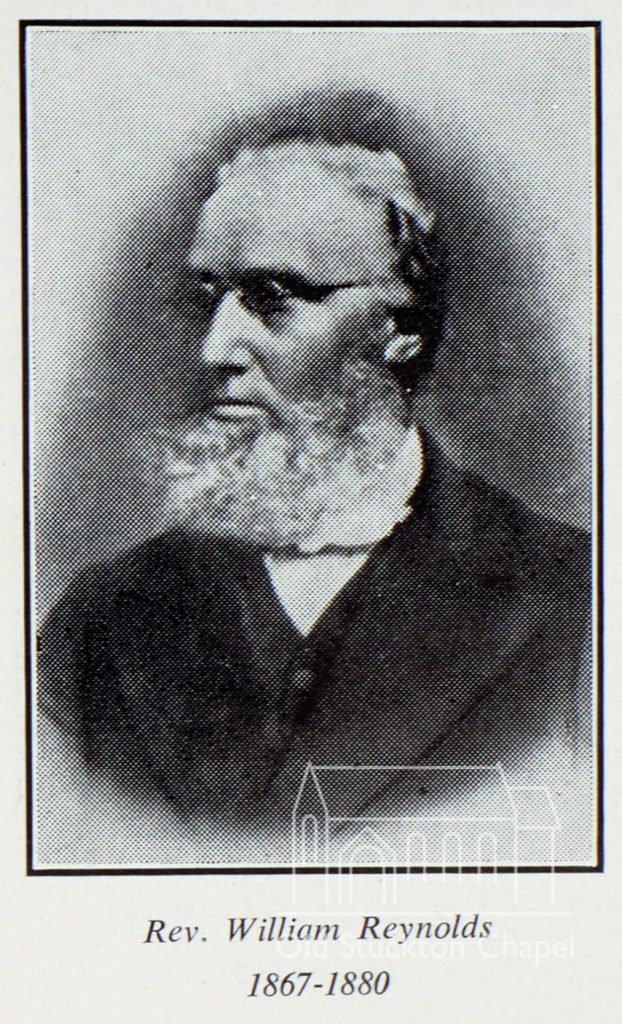
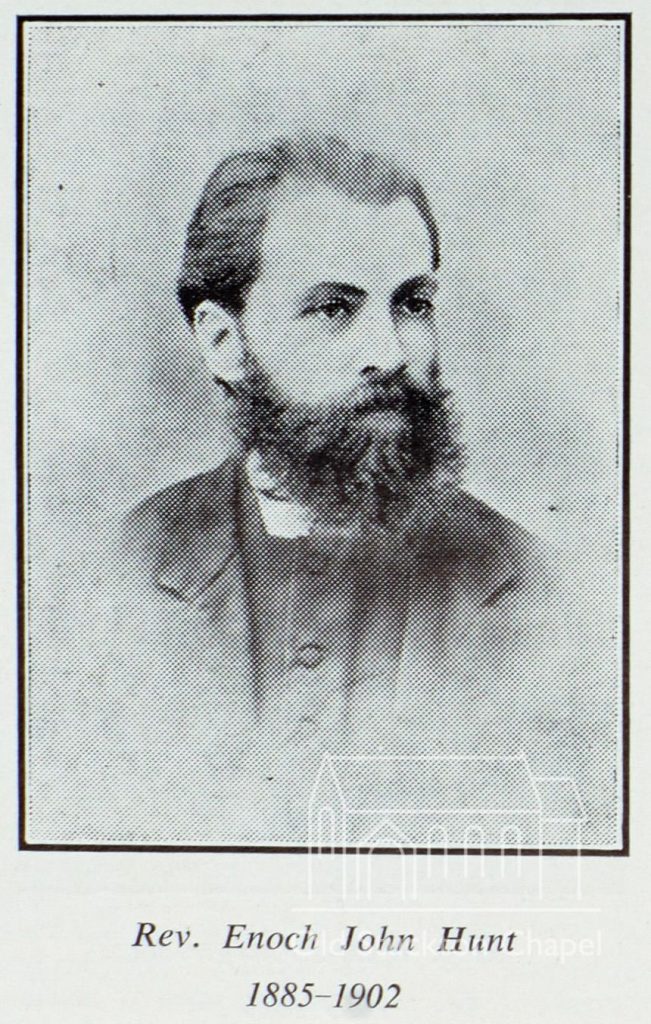
From the above point the records of the church are fragmentary. The ministers of the Fordingbridge Congregational Church appear to have had oversight of the chapel. The Rev. William Reynolds followed Mr. Grant in 1867, and was minister until 1880. The next minister was the Rev. A. W. Bennett, A.T.S. (1880-1885), and he was followed by the Rev. Enoch John Hunt in 1885.
On December the 12th, 1893, a heavy gale damaged the roof and end wall, and the church was faced with a bill for £120 for repairs. On September the 27th of the following year a fancy sale was held in the village of Gorley in aid of the repair fund. A church meeting in December 1895 received a report that the debt on the repairs account was now clear and there was £3 in hand. This money was used to register the chapel for the solemnisation of marriages. The clearing of so large a debt in so short a time by a village congregation is a testimony to the virility of the Church in those days. The first marriage in the Stuckton Chapel was on the 21st of November 1896, when the Rev. E. .J. Hunt officiated at the wedding of Mr. Charles Silley and Miss Rose Gilbert. At the church meeting referred to above, twelve new members were added to the Church roll upon their confession of faith in the Lord Jesus Christ as their Saviour, during special services partly arranged by Mr. Bray of the Evangelisation Society.
In March 1899, a new matter was discussed by the church, and it was finally resolved that a Miss Downer be paid l/- a week to keep the chapel clean. The same year the deacons received a complaint about the condition of the graveyard. Gravel, put down that same year, had been spoiled for lack of weeding and the path edging had not been trimmed. Mr. Downer proposed that the graveyard be left entirely in the hands of the deacons. The flourishing state of church finances in those days is also reflected in the motion that came before the December meeting, “that Mr. Lewis be paid £1 in recognition of his services at the harmonium”.
On December the 2nd, 1900, Mr. George Wort (who later became treasurer of the Stuckton Chapel) was voted into membership along with six others. At the same meeting Mr. Charles Lewis became treasurer of the church (an office he held for the next 45 years) on the retirement of Mr. Clark. The Balance Sheet for that year makes interesting reading. The weekly offerings for the year totalled £19 9s 9½d and the payment to the minister £6. The cost of coal and oil for limiting and heating the chapel for the whole year amounted to 12/-! It must be remembered that the minister at that time had oversight of other churches, all of which made small contributions to his support.
On January the 6th, 1902, the church received a legacy from a Mr. Croft of £108 13s. 6d. These minutes were eventually signed by the Rev. Guyon Marler, Mr. Hunt’s successor at the Fordingbridge Congregational Church.
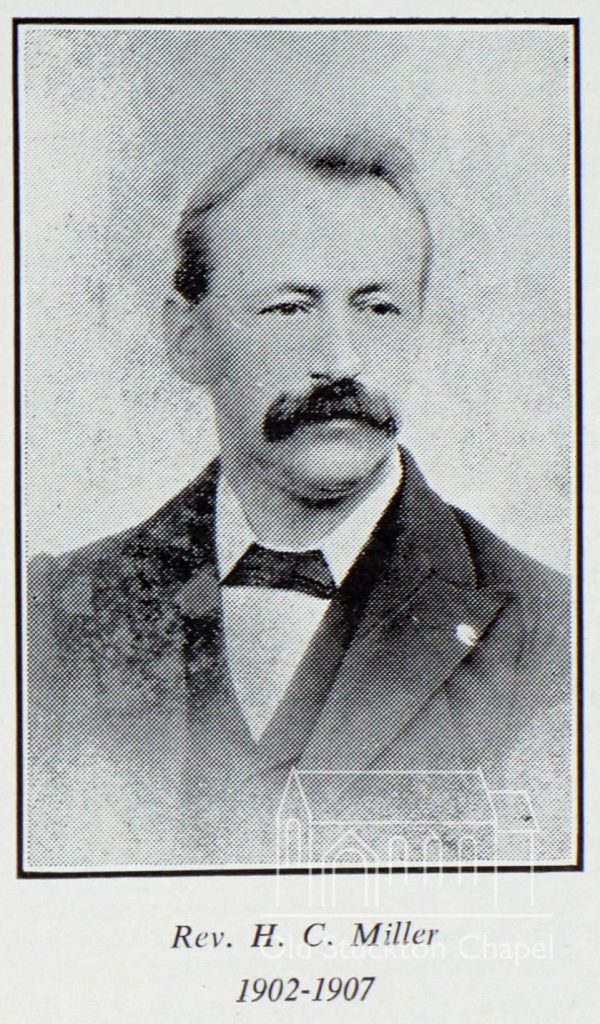
7 – The Pastorate of the Rev. H. C. Miller (1902-1907).
In the summer of 1902 the Rev. H. C. Miller accepted the call of the Stuckton Church, and a July Business Meeting voted him 3 months salary in advance. With the coming of Mr. Bert Miller to be “evangelist in charge of the Stuckton Church” a deeper spiritual note creeps into the Minute Book.
From now on the church meetings are opened with prayer. They probably were before, but now such things are recorded. In 1903 a weekly prayer meeting was started, also a Christian Endeavour Society.
A Sunday evening meeting also was started in Mr. Miller’s days. Up till then the services on the Lord’s Day had always been in the morning and afternoon. The Rev. Miller, preaching in the Fordingbridge Congregational Church, found that the evening service was attended by many from Stuckton, and soon took appropriate action.
On December the 14th, 1903, the deacons met to “talk over the best way us as Minister and deacons by the help of God could carry on His work for it to prosper.”
On January the 4th, 1904, the Annual Church Meeting was held and the following is an extract from the minutes: “The Secretary was asked to give his report, but that he said he did not understand what a secretary’s work was, but he learnt more at the meeting than he new beafore. Then the Treasurer was asked to give his report and he give his report and he give the Receipts and Expenditure ending the year 1903 satisfactory and all the members present agreed to his report and then Mr. Miller give his report he was glad to find that the work of God was prospering 2 have been added to the Church in the Past Year and at the Mission of Mr. Baines2 with us menney of the yung from the Sunday School have give theire Harts to the lord and some of the aduts and we pray that this may be the droping beafore the showes.”
We may smile at the spelling and the grammar, but let us ask ourselves are we as keen to observe the signs of spiritual blessing today? The secretary who wrote the above continued to serve the church faithfully for many years, so he was well instructed at his first Annual Church Meeting!
In the autumn of 1904 there was a minor crisis in the church because the chapel cleaner had to be sacked as many had complained about the state of the church and all representations to the lady concerned had proved in vain.
Later that year it was proposed to purchase a pipe organ, “the best and cheapest that could be obtained.” This instrument was installed early in December 1904, and opened on the 15th of the same month when the Rev. H. Lucas, of Wilton preached in the afternoon on “Praise”. In the evening Mr. Enos Watkins, organist of Richmond Hill Congregational Church, Bournemouth, gave an opening recital.
The Annual Church Meeting held on Tuesday, January the 10th, 1905, decided after “an interesting discussion that as a church we at once become affiliated with the Congregational Union of England and Wales, the fee being 5/- for a church with a membership less than 50”. The Minute Book reveals the church has played its part in the denomination since that date.
8 – The Jubilee – 1906
On October the 21st and 25th, 1906, the church celebrated the Jubilee of its opening. On the Sunday, the Rev. T. C. Riggs, of Woodfalls preached in the morning, and in the afternoon the Rev. W. Steen, A.T.S., and in the evening Mr. G. Billett, of Salisbury.
On the following Thursday the Rev. J. D. Jones, M.A., B.D., of Richmond Hill Congregational Church, Bournemouth, preached in the afternoon a most helpful and inspiring sermon from the text, “But as for me, my feet were almost gone, my steps had well nigh slipped . . . until I went into the sanctuary of God” (Psalm lxxiii, verse 2 and verse 7). After the service about 100 sat down to tea, and this was followed by an evening meeting, when Mr. E. L. Lane, J.P., of Bournemouth, presided over a crowded church. The devotions were led by one of the deacons, Mr. Henry Downer. The chairman urged all connected with the Stuckton Church to always stand firm and true to the great principles of our denomination. A very interesting letter was read from the Rev. H. J. Chancellor, of Bournemouth, regretting his inability through ill-health to be present, and stating how well he remembered being present at the opening of the church 50 years ago. There were seven people present who were present at the opening of the church on September the 16th, 1856.
“The Rev. J. D. Jones, in a very brilliant address, took us back some 50 years ago and dwelt at length upon the struggles of the Rev. Thomas Grant at that time, when being bitterly persecuted by the then squire and parson; and referred to the erection of the Church in 1856, which followed the ejection of Mr. Grant from the old chapel in Hungerford, as the clear evidence that God was standing by His servant who had for so many years faithfully preached the Gospel, and that now for 50 years the Church at Stuckton had been witnessing with no uncertain voice for religious liberty and freedom of worship.”
The Rev. Bert Miller expressed the gratitude of the church to all who had made the day so memorable.
On the last day of the same year (1906) Mr. Henry Downer, who had led the devotions at the Jubilee Meeting and had served the church faithfully for a great number of years, was accidentally drowned while at work on the River Avon, near Bickton Mill. He had for 20 years been superintendent of the Sunday School, and the hymns, “Peace, perfect peace” and “Someday we’ll Understand”, were sung at the funeral service by the teachers and scholars of the Sunday School.
At the Annual Meeting in 1907, Mr. G. S. Wort took office as a deacon. The next business meeting refers to trouble with the church roof, and the same year saw the departing of the Rev. H. C. Miller to Broadwindsor, Dorset, and the coming of his successor, the Rev. Frank Mead.
9 – The Pastorate of the Rev. John Baines (1910-1950)
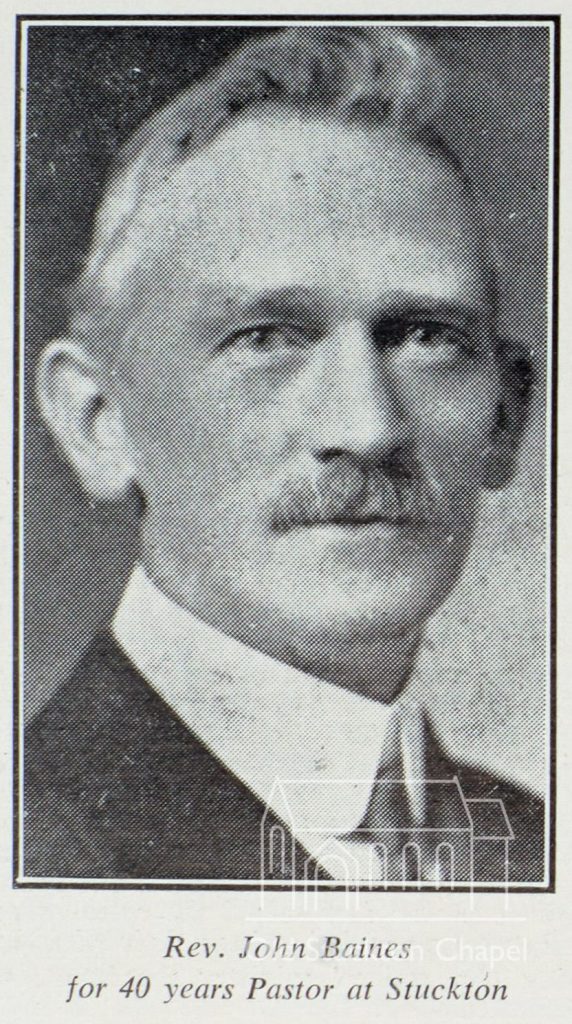
In 1910 the Rev. John Baines accepted the invitation of the church to succeed Mr. Mead. He was pastor of the Stuckton Group of Congregational Churches for the next forty years, and exercised a powerful and influential ministry in the district for the whole of that time. There are still many people who owe to the Rev. John Baines the conversion of their souls, and many owe almost all their growth in grace to the ministry of this one man. He was born in Stanground, Peterborough, and came of a musical family. Before his conversion he was first violinist at the Theatre Royal, Peterborough. After his conversion he gave up this position to take up Christian work and entered the Congregational ministry in 1899, and his first pastorate was at Hythe, Southampton. In 1903 he moved to Stockbridge, Hants, and in 1910 became the pastor of the Stuckton Group of Churches, which comprised the churches of Alderholt, Frogham, Godshill and Stuckton. Almost all his life he carried his violin wherever he went, and would accompany the hymns on his instrument. His life was one of great self-sacrifice, and he was a great believer in prayer. Many people in the neighbourhood still testify to healing after he had prayed with them, or promised to pray for them.
When Mr. Baines first came to Stuckton the average attendance on Sundays was 85, even so the annual meetings reveal a membership of approximately 25. In 1913 the members are reported to be very lax in their attendance at church meetings, most of the business being left to one or two faithful ones. In the same year the matter of the roof had again to be discussed by the church. It now leaked and the pipe organ was being spoiled. Eventually the damp was so great that the organ had to be dispensed with and a small American organ put in its place. In December 1913, Mr. C. J. Lewis became church secretary as well as treasurer and continued to hold the dual office until his retirement in 1945. In this year also the church was worried by what they called an attempt on the part of the Union to move Mr. Baines by withdrawing the annual grant they made to his support. The four churches rose to the occasion and raised the extra among themselves and so were enabled to keep their minister.
During Mr. Baines’ ministry the Stuckton Church was redecorated twice, the last time was in 1947.
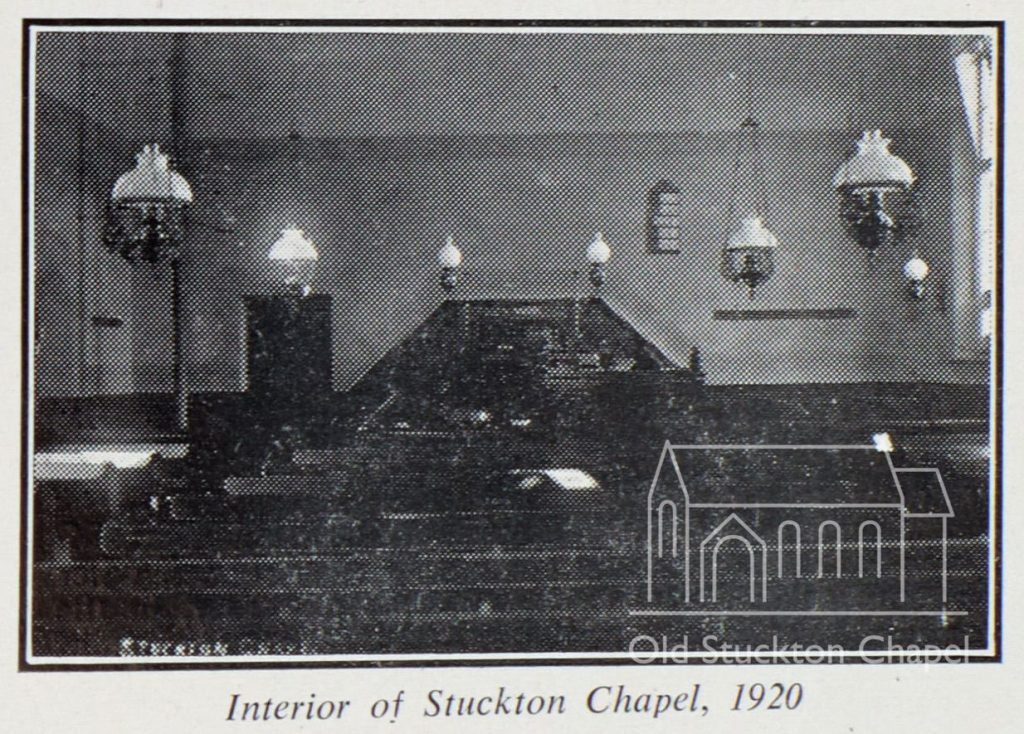
In 1937 electric lighting was installed.
The coming of the Second World War brought its own problems, but the leadership of Mr. Baines never wavered. It was during these dark days that the church received periodical visits from the Forces Gospel Team, of Bournemouth, the leader of which eventually became the minister of the church.
In 1945 Mr. C. J. Lewis resigned from the offices of secretary and treasurer on account of failing health and old age. Mr. G. S. Wort was elected treasurer, and Mr. W. G. Gosney accepted the secretary ship.
Mr. C. J. Lewis passed into the presence of the King he had served so faithfully in November 1948, aged 87. In his passing the church not only lost an office bearer of great integrity, but also lost a friend and brother in Christ, whose whole life had been spent serving the Master in the Stuckton Church.
He not only acted as secretary and treasurer for a great number of years, but also was active in keeping the church in a good state of repair. Many were the small and great tasks he did in this way, and many, no doubt, were never discovered by others, so quietly and efficiently did he work for his Lord and His Church.
In June, 1950, Mr. Baines terminated his ministry. He had been in failing health for some time, and it was a sad day for the church when they realised his long and faithful ministry must end. The four churches got together and, assisted by many friends in the neighbourhood, made a presentation to him. The presentation meeting was held in the Stuckton Church and was presided over by the Rev. Maxwell Janes, a former moderator of the Southern Province of the Congregational Union. Tributes were paid to Mr. Baines by representatives of all the four churches, and friends from other churches.
All spoke of their long and happy associations with him and of his valuable help and guidance over many long years. The Rev. Maxwell Janes made the presentations, saying it was a great privilege to be asked to do so. There were two presents, first a wallet and a cheque for £155 10s from the Stuckton Group of Congregational Churches, and a second cheque from the church in Hythe, where Mr. Baines had begun his ministry 51 years ago.
The Rev. John Baines, responding, thanked everyone for the gifts and the kind things that had been said of him that evening. He said he did not feel he was retiring, but just laying down the responsibility of the group of churches. “I am not ceasing work and I have no intention of really taking things easy. I do not feel I could live with nothing to do, and I hope to do much more good work in the ministry yet.”
The Rev. Maxwell Janes gave an address and stated that as one John Baines laid down his work, a second John Baines, his grandson, was taking up the work in the Congregational ministry.
The following year, in May 1951, the Rev. John Baines was called home, and five months afterwards Mrs. Baines likewise was ushered into the presence of the King.
He was buried in the Stuckton Chapel graveyard. Deacons from the four churches carried his body to its resting place. The Rev. W. S. Griffiths, of Fordingbridge, conducted the funeral service and many tributes were again paid to the humble and effective witness by life and lip of Mr. Baines to his risen Saviour. Among those who took part were the Reverends. A. W. Williams (Verwood), H. I. Frith (Secretary of the Hampshire Congregational Union) and S. W. Allen.
10 – 1950-1957
In 1952 the Rev. E. T. C. Wheeler accepted the invitation of the group of churches to follow Mr. Baines. During his pastorate a Women’s Guild was commenced and it continues to meet once every month. In 1954 the Rev. Wheeler accepted a call to Petersfield, Hants.
In July 1955, the Rev. Leslie Alcock came and received a very warm welcome into the fellowship of the Church. He had known the fellowship since 1942 when, as leader of the Bournemouth Forces Gospel Team, he had brought the Team regularly for Sunday services. Now, coming as Pastor, he found the Church was not a large one and unlikely ever to have a large membership, but the fellowship in Christ was warm and firmly believed in the saving grace and power of the Lord Jesus Christ. His first task was to undertake the final planning of the Centenary meetings.
The Centenary Meetings in September 1956 were days of inspiration. It had been hoped to redecorate the interior of the church in time for the celebrations but this proved impossible, but what was possible was the installation of flush toilets with fitted hand basins. Over a long period of weeks, six hundred working hours in all, a band of men led by Mr. John Drew accomplished a ‘do-it-yourself’ job. Lady members of the church gave necessary encouragement by providing cups of tea and refreshments at appropriate intervals as the work progressed.
On Centenary Sunday, the Rev. Maxwell Janes was the preacher. As a previous Moderator of the Southern Province of the Congregational Union, he had been a good friend of the Church in previous years and also had been a one time minister of the Above Bar Congregational Church in Southampton where, as a young man, Thomas Grant had gone seeking spiritual enlightenment and the then minister, the Rev. Thomas Adkins, had led him to yield his life to the claims of the Lord Jesus Christ. There were nearly three hundred present in Stuckton Chapel for the evening Praise and Thanksgiving Service, which began at eight o’clock to enable friends from other churches to attend. The centenary was also mentioned on a B.B.C. West country news programme the same day.
The Centenary Celebrations continued on the Wednesday following. The Rev. A. W. Williams of Verwood, Chairman for that year of the Dorset Congregational Union and who, as a young man, had been led to faith in Christ by the Rev. John Baines and a long standing friend of the church, led the afternoon worship at 4 o’clock. At the tea, which followed, Mr. George Wort cut a large iced cake, which had been given by Mr. W. Sandy and his sister, both past members of Stuckton Church.
In the evening the Church was full to overflowing. The Chairman of the Western District of the Hampshire Congregational Union, the Rev. A. Dewhurst of Winton, Bournemouth, presided and the Rev. Trevor Davies, M.A., B.D., Ph.D. of Richmond Hill preached. His great predecessor at Richmond Hill, the Rev. J. D. Jones, had done the same at the Golden Jubilee. Dr. Davies gave a masterly survey of the differing religious climate of one hundred years ago and today and of the faithfulness of God through the years. God blessed the word to many hearts.
At the Annual Meeting of the Church in January it was decided to invite Mr. Joe Bush of the Caravan Mission to Village Children to visit us in the Spring for a week’s mission, to be followed by another week at the sister church in Alderholt. Also at this meeting, warm tributes were paid to Mr. George Wort who had just completed fifty years as a deacon of the Church. Later in the year, a certificate commemorating Mr. Wort’s long and faithful service as Deacon, and also his many years as Sunday School Superintendent and Treasurer, was presented to him.
Mr. Bush eventually came and a most profitable week of meetings was held, ending with a Sunday evening rally which had been planned at the last minute, in which the Church was once more filled to capacity.
Later that year the Church faced the problem of redecoration and decided the outside should be painted first, at a cost of £65, and the interior should also be done after the problem of discolouration of the walls had been dealt with. The cost of the interior painting would be £200 and this was to include a midnight blue ceiling after one hundred years of plain white.
At the beginning of August the Rev. Leslie Alcock informed the Church that he had accepted a call to Stanwell. The call was especially challenging for Stanwell was a new estate, housing workers at London Airport, and he would have to lead the church while a new building was erected. He had initially received the invitation in January and for eight months had fought against accepting it, but now was firmly convinced it was the Lord’s will for him to go. The parting was one of great reluctance on both sides but was made easier by the fact that this move was of the Lord. Mr. Alcock’s place was not filled for nearly two years but the work of the church went on. The final cost of the redecoration was £356 17s. 6d. Soon another problem had to be faced for the heating of the church was becoming an increasing burden and there was also the recognition of the fact that, if another minister was to be called, the membership would have to find another £8 a week towards his salary and it had been hard enough to find the current amount.
11 – The Pastorate of Derek Anderson (1960-1964)
Early in 1959 Mr. Peter Anderson, a member of the staff of the National Young Life Campaign, came to Stuckton for an evangelistic campaign. In the middle of the series of meetings Mr. Anderson’s voice broke down and his brother, Derek Anderson, came to take his place. The Church members were attracted to the latter and in October a specially convened Church meeting invited him to be the next pastor. The other churches’ in the group were also eager for him to come. Mr. Derek Anderson accepted the invitation and began his ministry in January 1960. He presided over the Annual Church Meeting that month when the heating of the church was discussed and a substantial balance in hand was reported.
In July 1960 the Church suffered a great loss in the passing from this earthly scene of Mr. George S. Wort. He had enjoyed a life-long association with the Church: he had been a faithful servant and good friend to it for over sixty years. His faith in the Lord Jesus was clear and also the mainspring of his life.
Mr. John Gosney, son of the Secretary of the Church, was appointed treasurer in the place of Mr. Wort. In September of the year a Young Peoples Fellowship was commenced and, in the winter, it was noticed that the roof of the Church would soon require repairing.
In 1961, Mr. Bernard Cheater was asked to design and install a sink unit, which he did. A legacy of £100 was received from the executors of the late Mr. H. A. Bush of Hyde and the Church took the important decision that in future Harvest Gifts should be given away and not sold for the benefit of church funds as had been the case for many years. It was also discovered that the local men who had been appointed Trustees many years ago were all dead and an approach was made to the Hampshire Congregational Union to become Trustees.
The Annual Church Meeting in 1963 had to be postponed because of the severe winter weather.
During this year four people were received into membership, an event that caused all to rejoice. The next year two more were received into membership and also a wedding took place. Miss Eileen Wort marrying Mr. C. Coles. 1964 also saw a renovation of the Sunday School by the men of the church and also the fitting of curtains under the gallery. The Y.P.F. offered to decorate the Sunday School and toilets and, as a contractors estimate for the work was £100, the Y.P.F. got the job.
On the 21st of October Pastor Anderson said farewell, having accepted a call to the Colchester Railway Mission. There being no pastor to provide for it was decided to pay the caretaker £7 10s. 0d. a quarter.
Early in 1966, Mrs. Wort resigned as organist. Like her late husband, she had given long and faithful service to the Church, her association with the Church going back to the early years of the century.
12 – The Pastorate of the Rev. Philip Williams (1966-1973)
In April 1966 the Church faced a decision, which would affect the whole of its future. It was asked by the Congregational Union of England and Wales, which had come into being in 1833 and Stuckton had joined in 1905, to enter into a covenant with every other Congregational Church in England and Wales. The Rev. Leslie Alcock was invited to come and explain the issue to a Group Meeting. He came and gave a fair and balanced view of this important issue. The outcome was that the members of the Group felt that loyalty to Biblical truth and the independency of the local Church would be compromised by covenanting and unanimously decided not to covenant and enter the new doctrinally mixed Congregational Church in England and Wales. This issue had a most disturbing effect on many churches and in some, where the minister’s views differed to that of the congregation, the minister was told to go. Mr. Alcock knew of one such minister and, after the above decision was made, he asked the Group to consider as their next minister the Rev. Philip Williams of Newbridge, South Wales. Mr. Williams preached with a view on the first Sunday in May and the group were quickly persuaded that it was the Lord’s will for them to come together as pastor and people. He was inducted to the pastorate on the 29th September. The chair was taken by the Rev. Leslie Alcock, and the Rev. Derek Swann, B.A., B.D., of Ashford, Middlesex, a friend of the new minister, gave the charge to the Minister and Mr. Alcock that to the Church. Mr. Williams made it very clear in his statement respecting his acceptance of the call that he had resigned his ministry at Newbridge because the church there was entering into the covenant and that he felt that they were giving away the freedom which the early Congregational forefathers had lived and died for and he wanted to continue to preach the faith once delivered to the saints.
The Church, soon after Mr. Williams’ arrival, decided not to support the London Missionary Society any more but to help Evangelical Missionary Societies.
In 1967 there was a change of treasurer, Mr. John Gosney’s occupation taking him to Evesham, and Mr. Hartley Wort took his place. The same year Cripplestyle Congregational Church joined the Group.
The following year found the Church seeking to get its deeds back from the Hampshire Union. The men of the Church, led by Mr. John Drew, carried out a major undertaking. The roof was stripped and lined with heat resisting material and some of the rafters were repaired and replaced. The work took from May to October and finally there was much praise to God that this long and difficult work had been accident free.
In April 1969 the Hampshire Union agreed to relinquish their trusteeship and local friends were appointed in their places. They were Messrs. W. G. Gosney, A. E. Cheater, J. G. Drew, B. A. Cheater, H. G. Wort, C. G. Coles, A. H. Brooks, J. H. Brooks, H. Marlow, L. J. Harris, W. C. Siviers, H. W. G. Pressey, P. Wallis and D. Manstone. It was not until the following year that the Deeds were actually obtained and deposited in the Bank. In this same year (1969) a great friend of the Church, Mr. T. Spicer, was called to his eternal reward and the Church benefited from his will.
In July 1970 a doctrinal issue came to a head. Some members of the Group of Churches questioned the minister’s views on Infant Baptism. The Rev. Williams took the view that such Baptism was only for the children of members of the Church and that a service of Thanksgiving should be offered to the children of non-members. The issue dragged on for a long time with Mr. Williams at one point offering to resign from the pastorate. The issue was finally resolved at the end of November 1971 and Mr. Williams withdrew his resignation.
Although the finances of the Church were low the re-decoration of the building had to be faced once again, the south wall of the church especially giving concern. The accepted estimate was for £395.
In August 1973 the Rev. Williams accepted a call to a church in South Wales. This was a sad day for Stuckton for, although he had seen little by the way of conversions or numerical growth, he had proved to be a good friend, a careful pastor and his preaching and teaching ministry had been the means of building up the people of God and establishing them deep in the Word of God. It had been a truly happy association and it was only the persuasion that God had made clear His will that the pastorate was brought to an end.
During Mr. Williams’ pastorate the Church had entered into fellowship with the Evangelical Fellowship of Congregational Churches, a body of like-minded churches.
13 – The Pastorate of the Rev. Martin Price (1975-1982)
After Mr. Williams left one or two men came with a view but they did not meet with acceptance and then, in April 1975, Mr. Martin Price offered himself and the Group of Churches felt that this was of the Lord. Stuckton held a joint meeting with the friends of Frogham Chapel and were unanimous that Mr. Price be called. The other churches in the Group were of the same mind and the call was accepted and Mr. Price inducted into the Group pastorate on the 17th of June 1975.
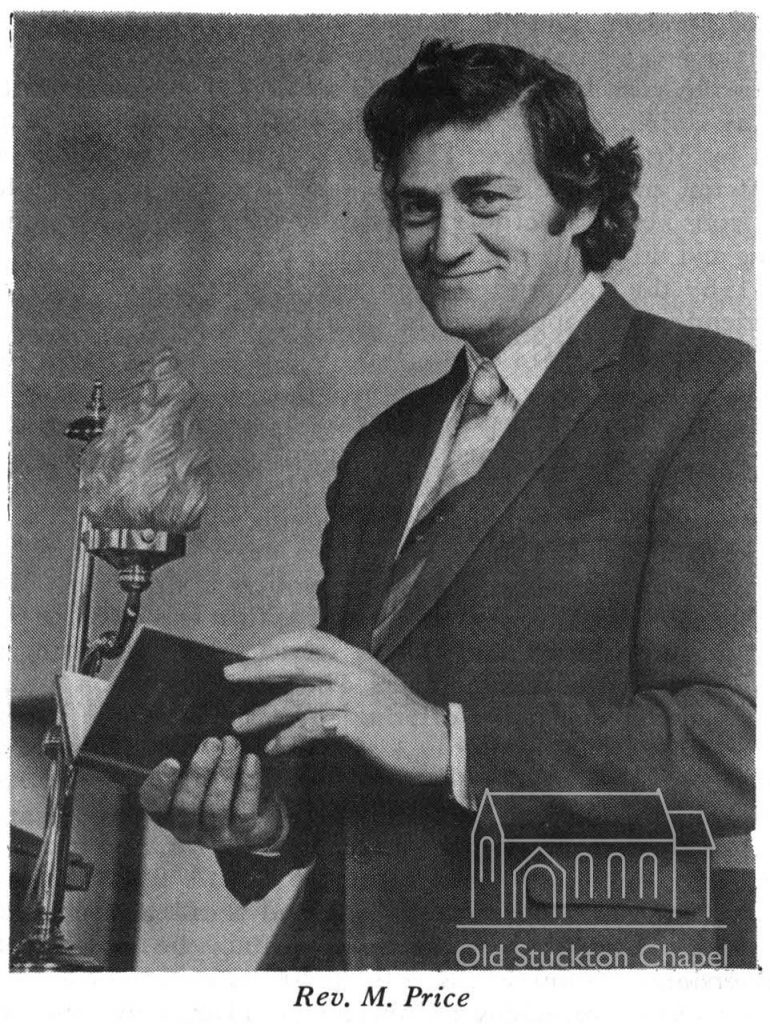
At the Annual Church Meeting of Stuckton on the 20th January 1976, Mr. W. G. Gosney resigned from the office of Church Secretary. He had been asking for years to be relieved of this work but the members of the Church had been reluctant to let him go. A kindly, quiet, unassuming, spiritually minded gentleman he had been secretary for over thirty years and no one can estimate the debt Stuckton owes to his faithful, efficient and Godly years in office. Mr. John Drew, another to whom the Church owes more than it can ever know, took on the Secretaryship from Mr. Gosney. Also in 1976 ‘Adventurers’ now called ‘Followers’ – was started for young people. Also the same year Hymns of Faith became the book used in services.
In spite of inflation of the last few years the Church continued to meet its responsibilities. In 1979 the income of the Church was £1,443 and expenditure £1,328, with £153 given to Missionary Societies.
When these figures are compared with those that have been mentioned previously, you get some idea of the enormous rise in prices this century and especially since the last war. When the writer first came to Stuckton in 1942 with the Bournemouth Forces Gospel Team, Mr. Gosney was announcing collections of around £1 per week and the Church was paying its way. Now the figure has to be well over thirty times that amount. It is with much praise to God that He is enabling the Church to meet this figure.
Under Mr. Price’s able leadership the work and witness of Stuckton and the Group of Churches to which it belongs continues, with God’s gracious help, to proclaim the unsearchable riches of Christ and to seek the salvation of the lost. It is with gratitude to God and in the confidence of His continuing favour that this history has been brought up to date.
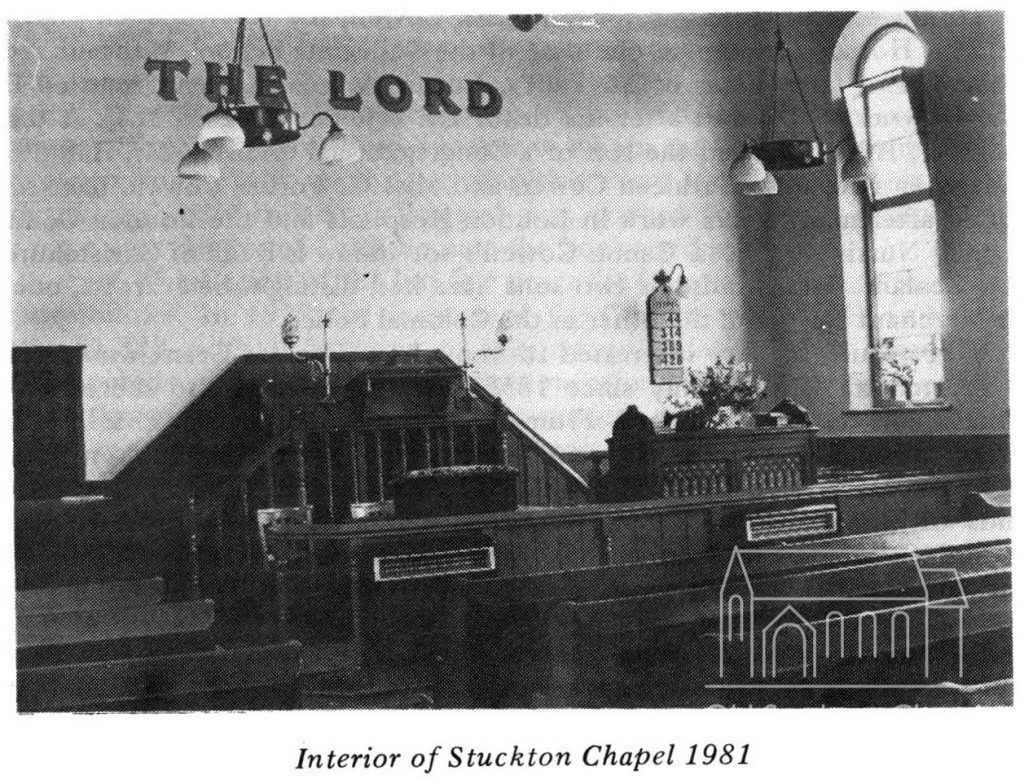
In November 1982 the Group reluctantly accepted the resignation of Rev. Martin Price. It had been realised that, for some time, he had felt under pressure from various angles, not least having responsibility for four churches. He contributed a great deal to Stuckton and the Group particularly in the field of youth work and many young people were influenced by his ministry and also that of his wife Faith. It was with gratitude to God that the years he spent with the Group were remembered.
Once again, the church relied entirely on the ministry of local preachers for all services and a willing supply was always available. In particular, Mr. Charles Charman of Alderholt was always very helpful.
On 24th June 1983, a flash flood engulfed the village, the result of several days of rain followed by a heavy thunderstorm. The Church, vestry and schoolroom were flooded to a depth of 4 inches. There is a space of some 18 inches beneath the floorboards, so this gives some idea of the depth and strength of the water, which rushed through the adjoining shop and churchyard, doing considerable damage. The cleaning-up bills for the church, despite volunteers, amounted to £476.
Mrs. M. Drew continued as organist from 1966 and Mrs. E. Coles was now appointed deputy.
In 1984, Mr. and Mrs. B. Cheater reported that after many years of hard work, the remaining four pupils would not be attending in future and so the Sunday School was closed with much regret.
14 – Pastorate of Rev. Dennis Scurrell, 1984-1996
One or two candidates applied for the post of pastor but that of Pastor Scurrell of Essex met with the unanimous approval of the group of Churches and he agreed to take up his appointment in March. They thanked God for His leading in this matter and looked forward to Pastor Scurrell’s ministry.
In November 1985 the Lay Preachers Appreciation Evening was a great success, addressed by Rev. Peter Williams of Moordown. The Church was filled to capacity.
In 1986 and 1987, the Church suffered a great loss with the passing of Mrs. A. Bartlett and Mrs. A. Cheater after many years of service to the church, particularly with regard to the Women’s Guild. Mrs. E. Coles was appointed to the post of president.
Thanks were recorded to Mr. R. Lock for allowing the continued use of his farmyard for car parking for special events.
Miss Sarah and Miss Rachel Coles were asked to lead choruses before the morning service and during the taking of the offering.
The death of Miss Mabel Gosney, a lifelong member, occurred in December 1990 and was recorded with regret.
In 1992 five new members were received with pleasure. The membership now stood at thirteen.
Mr. A. Brooks generously donated a Hammond electric organ.
The church learnt with regret of the death in Cambridge of Mr. D. Wort on 28th July 1992. Although not a member, he had a lifelong connection with the church, particularly with regard to music.
Mr. John Drew, Secretary, was asked to approach the Coles family, who own the neighbouring property, with regard to the church septic tank, which had been built on Coles’ property with permission but with nothing in writing. It was felt that this should be regularised, and the boundary shown on the deeds altered, perhaps by the purchase of the piece of land involved.
In 1993, monthly visits of the “Sonshine Library of Jesus Christ” were arranged. Its organisers were Mrs. Sally Green and Mrs. Megan Murray, assisted by their husbands. It took at least 1600 Christian books and some 700 videos and tapes, monthly, to various venues which could be borrowed free of charge. They undertook this as their Christian ministry and as can be appreciated, it involved a lot of hard work, shared at Stuckton by some of our members. It was a great success and between 20 and 30 people would come and share fellowship and refreshments as well as borrowing books. This continued until Sally and Megan felt called to a different avenue of service in 1999.
It was decided that the evangelical movements “CFAN”, Christ for all Nations, and “JIM”, Jesus in Me, should be supported financially. The Church’s missionary giving to WEC and the New Tribes Mission, also our contribution to Group funds should be increased. All this reflecting a healthy financial position. The Church also benefited from bequests by Mr. J. Wort, Mr. D. Wort and Mrs. M. Gosney.
It was decided, in 1995, to enter a decorated float in the Fordingbridge carnival with a Christian theme. “The Greatest Story Ever Told” was chosen and everyone enjoyed the work of preparing this as well as the actual day, which was fine and sunny.
Mr. J. Drew asked that, in view of his ill health, a replacement secretary should be appointed. Members expressed their deep concern for him and his wife Margaret and fervent prayers were made for his recovery.
It was proposed that Mr. G. Sadler should undertake the task of secretary, which he accepted.
Unfortunately, Mr. Drew died on 20th August 1995 and the Church lost a friend and loyal servant of many years. He had served variously as Sunday School Superintendent, Secretary and YPF leader; also undertook local preaching engagements: many people were influenced by his Christian teaching and example.
In 1996, the news that Pastor Scurrell was intending to retire after 12 years of ministry was received with great regret. The benefits of his loving ministry with that of his wife Ethel, had been felt by everyone, especially the elderly and sick who he visited with great faithfulness. They were both wished a long and happy retirement.
Due to the condition of the piano in the schoolroom, it was decided to replace it with that in the church and purchase a digital piano for the church. Accordingly, a Korg instrument was obtained at a cost of £899, which met with everyone’s approval. The old American organ, which was purchased new in 1913, was advertised for sale and realised £200.
It was discovered that the schoolroom window had been forced and the Hungerford communion cups and goblet, donated at the opening of the Church had been taken from a locked cupboard in the vestry. As very little else of value had been taken it appeared that this had been stolen to order. Thanks to the efforts of the police, they were recovered but in a somewhat damaged condition but were subsequently repaired. They said that in another day or two they would have been melted down and we felt that God’s hand had been on the church in a special way in this incident.
It had long been the ambition of the members to update and refurbish the interior of the Church. The financial position was such that this could now be carried out and it was decided to proceed. Quotations were obtained for decoration and repairs, 100 new upholstered chairs to replace the original, and now very shabby, pews, new heaters and carpet. The decorating and repairs quotation from Mr. Peter Cuthbert was accepted and special mention of this must be made as he treated us with great generosity. Very shortly after the completion, the Lord called him home. Mr. G. Sadler, the secretary and a signwriter, painted the inscription “Jesus Name Above All Names” above the pulpit as a gift. Everything was finished in time for the 1997 Carol Service. The total cost was £17000.
A celebration service for the completion of the Church refurbishment was held on 28th February 1998. Mr. Henry Piper preached, and an opportunity was given for everyone connected with the project to be able to contribute. 135 people attended and praise was given to God for His provision in making this possible and that the building would continue to be used for His glory.
New china was purchased, to be used for refreshments at special events and also NIV Bibles for Church use together with new hymnbooks entitled “The Source” compiled by Graham Kendrick.
Giving to Group funds was increased to £538 per quarter and further legacies were received from Mr. J. Drew and Mr. R. Grant, a descendant of the founder, Rev. Thomas Grant.
15 – Pastorate of Rev. Bruce Jenkins (1998-2001)
The Group had been seeking a new pastor for some time and the name of Rev. Bruce Jenkins from USA was put forward by WEFCC. He visited the district with his wife for about a week and it was felt he would be suitable. He accepted our invitation to come for 3 years and his coming was looked forward to as being someone who would perhaps broaden our horizons, with his worldwide experience. After some delay, they arrived, and his induction service was held at Stuckton on 17th October 1998.
A Group Sunrise Service was held on the Easter Sunday in 1999 on the common near Frogham chapel and was well attended.
22nd May 1999 saw the happy occasion of the wedding of Miss Sarah Coles and Mr. G. Baker.
Mr. A Symes was asked to cut the grass in the churchyard as a business arrangement. Volunteers had previously done this, but it was felt that this was too large a task to continue. Thanks were expressed to all those who had helped.
Mr. D. Watkins satisfactorily decorated the exterior of the church.
Cripplestyle Church closed at the end of 1999 with most of the remaining members joining with Alderholt. This meant that the Group now consisted of Alderholt, Frogham and Stuckton.
A formal Church constitution for Stuckton was prepared by Rev. Jenkins and accepted by the members.
A legacy was received from Rev. L. Alcock.
It was agreed to commence the Sunday morning services at 10.30 instead of 11.00 in the hope that more people might feel encouraged to come.
In February 2000, an outreach exhibition lasting a week with various events took place organised by the Church to celebrate the Millennium called “Jesus 2000” at the Town Hall, Fordingbridge. There was not a great deal of response except the closing Saturday evening service, which was very well attended.
Mr. H. G. Wort retired as treasurer after some 35 years’ service. Mr. G. Baker replaced him.
It had been concerning the members for some time that the Church had not grown appreciably and unless progress was made the future was not secure. It was felt that younger members were badly needed. Much prayer had been made in recent years for this situation. It was, therefore, decided that, as an outreach project, a Gospel service should be held on Sunday evenings at the Town Hall in Fordingbridge commencing in February 2001 instead of the usual service at the Church. All were agreed that this should be done for a trial period of 6 months. And was supported by all members and friends. The Town Council was willing to rent the hall at a reasonable cost. A letter was drafted to be sent the residents of Fordingbridge explaining our aims at 30 letters a week at a cost of £1000 for the period. This was to be called the “Avon Gospel Initiative.“
In February 2001, at a special Group meeting, it was announced that Alderholt had grown sufficiently to be able to call its own minister. They had gone from strength to strength and were also planning to enlarge the church building. While this was a matter of great rejoicing, it effectively meant the disbanding of the Group and would leave Frogham and Stuckton without the encouragement and guidance of a minister. They were not sufficiently financially strong to support their own but gave each other mutual support where possible. Any money left in Group funds would be divided between the three churches.
In October 2001, Pastor Bruce Jenkins informed us that he would be returning to USA having completed the three years provisionally agreed. Appreciation was expressed for the work he had put in during his stay.
The future of the “Avon Gospel Initiative” was reviewed and opinion was divided as to whether to continue, as there had been very little response. It was agreed to review the situation again at the end of October.
Mr. G. Sadler requested financial assistance so that he could devote more time to Church work and this was agreed.
A successful harvest supper was held at the Church to which friends who had given assistance during the year were invited.
In 2002, the Church joined in the various village celebrations to mark Queen Elizabeth 2nd’s Golden Jubilee. Meetings were held in the schoolroom to discuss the activities, which included a village walk, a barbecue and an exhibition of memorabilia in the church, all of which were well attended and appreciated.
In August 2002, there was now a serious division of opinion as to whether the Sunday evening services at the Town Hall should be continued or some other form of outreach pursued. For some time, two members had opened the Church for a short service on Sunday evenings as they felt its continued closure was not acceptable.
In spite of the lack of support they were receiving from the other members and from the public, letters of resignation were received from the elder/secretary, treasurer, organist, pianist, assistant secretary and two deacons. They proposed to hold morning and evening services at the Town Hall as from 9th September 2002 under the heading of the “Avon Gospel Initiative”, which was effectively no longer connected to the Church.
At a meeting of the remaining six members and one regular worshipper, it was decided that, in spite of their small number, they would do their best to continue the witness of the Church and much prayer was made for guidance in the days ahead. As the 150th anniversary of the opening of the Church was approaching, they felt that the hope and trust of the founders was vested in them, also they were custodians of the beautiful building.
The following officers were appointed – Secretary Mrs. J. Motie, Treasurer Mrs. S. Wort and pianist Mrs. M. Drew. Two members felt that, although they would not resign, they could no longer worship there on regular basis as they had been so distressed by the division but they would be supportive in other ways.
The two regular worshippers were received into membership which was a matter for great encouragement.
On 29th November 2003 the Church was delighted to provide the venue for the wedding of Miss S. Currie, a local resident, and Mr. F. Frankovitch of U.S.A.
In February 2004 the death occurred of member and former treasurer Mr. H. Wort and, in February 2005, that of Mr. H. Dymott: both after a lifelong connection. This further depleted the members and they were both sadly missed.
At a members meeting on 17th June 2004, it was decided that, due to the age and lack of experience of the Stuckton trustees, the trusteeship would be transferred to the E.F.C.C. Trust Corporation, this to be done after the boundary change previously mentioned was completed.
A very good friend of the Church and one of our regular preachers, Rev. D. Drapper, proposed a meeting should be called of people interested in the future of the church and suggestions asked for to forward its growth.
This took place on 20th February 2005, with a very good response and several people made offers of practical help. Discussion took place as to whether it would be helpful to hold an afternoon service instead of the morning. It was decided to continue with the morning but have a special Sunday afternoon service every 2 months or so with a speaker and possibly slides, interspersed with coffee mornings. These suggestions were acted upon with encouraging success. Unfortunately, the Sunday evening services had been discontinued due to the age and health of the members. There are now 3 members who regularly attend, supported by a few good friends.
Rev. M. Riches, Vicar of Hyde Parish Church, suggested that he would like to hold a communion service for all the Churches in the district on a Wednesday morning once a month. He was also proposing to hold an Emmaus course during the winter and would be pleased to use Stuckton Church for these. This was welcomed and both have been well supported and appreciated.
The Church is now approaching its 150th anniversary with a sense of great thankfulness to God for His blessing and guidance in the past and especially in these last difficult years. Although the numbers attending the morning service is very small, there is a great feeling of unity and the Word of the Lord is faithfully proclaimed by the willing supply of local preachers. They ask for your prayers so that they may rightly interpret and carry out His will in the future.
16 – The Descendants of Thomas Grant.
It is not only interesting to review the past and the work of the various people who have had a share in the life and work of the church, but it is also interesting to know something of their descendants.
Do those who follow remain true to their fathers’ faith and conduct?
One of the descendants of the founder of the Stuckton Chapel has forwarded the following details: “Thomas Grant himself was a righteous man and transmitted to his children the solid gifts of character which carried him through the adversities of his own lifetime.
“Two of his daughters in particular had these gifts. One, Nellie Grant, married a Mr. Ballard, who died leaving her with several young children. There was no welfare state in those days, so Mrs. Ballard emigrated to Canada where by ability and personality she set up a business and a home, and earned enough to educate her children. Today, the great-grandchildren of Thomas Grant are to be found in Toronto, Peterborough, Ontario, and in Pennsylvania, U.S.A. Almost without exception the family have been engaged, and successfully engaged, in the engineering profession. Another daughter, Elizabeth, married Mr. M. Cowen in 1876. She lived until 1924 after seeing her family of eight take high place, unobtrusively, in the world of usefulness to others. From this marriage of Elizabeth Grant have come two clergymen, and four nurses. Today there are grandchildren of Mrs. Cowen holding high office in Church and State. Her sons, Stanley and Claude, were both ordained in St. Paul’s Cathedral in 1903 and 1905 respectively. The latter died in 1936, and was a Canon of Auckland, New Zealand, a man loved for his Christlike life. Stanley was for a long time Headmaster of Seaford College, Sussex. The youngest son, Alexander, died in South Africa in 1909, having served in the South African War with distinction.
“Of the five daughters of Mr. and Mrs. Cowen, the elder, Mabel, married the Rev. Horace Lindsey, at one time of the Collegiate School, Wangaui, New Zealand, and later Vicar of St. Paul’s, Luton. A second, Irene, married Dr. A. C. Downer, D.D., and after his death Dr. F. J. de C. Veale, M.D. A third daughter, Hilda, married the son of a Congregational minister, Mr. Hamilton. The other two, Miss Kathleen Cowen and Miss G. Forbes Cowen, have now retired after many years work in London Hospitals and the London County Council Nursing Services. Canon Cowen’s son-in-law is Dean of Christchurch, New Zealand. Mrs. Lindsey’s two sons have had distinguished careers, one in the Merchant Navy and the other in the Colonial Police.
One would be very interested to know how Thomas Grant would react to the record of his family since 1856. They have tried and succeeded in living up to his high standard. From the Stuckton cottage his character has spread through his children, grandchildren and great-grandchildren to the back blocks of New Zealand, to Canadian towns and villages, to the new lands of Rhodesia and Kenya.
Truly his works do follow him. The small beginnings in the Stuckton cottage have become a great tree of service to God and man.
PDFs of all 3 versions are available on the History Booklets page.